

Reaching the north coast of the Northern Ireland, I think we have reached the peak of Irish landscape.
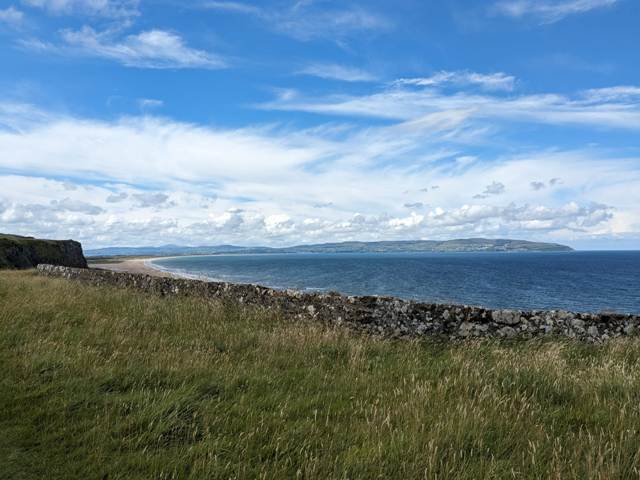
No wonder the popular fantasy series Game of Thrones was filmed on some of the locations of Antrim County as it is truly magnificent piece nature.
The sun appeared early in the morning and followed us all the way to the evening. It was probably the ONLY FULL SUNNY DAY during our trip.
It wasn’t sunny enough to have a swim, we learned that the other day but still quite warm to enjoy the day on several outdoor locations.
Since the distance between Derry and the next location wasn’t long enough for M car nap we decided to prolong it a bit by taking the longer route.
We passed Muff (my Croatian readers will understand 🙂 and embarked on a seasonal ferry connecting Greencastle and Magilligan Point.


The Causeway Coast is probably one of the most scenic routes in whole of the Northern Ireland. With incredible views of the North Atlantic Ocean and points of interest like the world’s oldest Irish whiskey distillery (Bushmills) it attracts half a million tourists a year.

We were part of those numbers.
MUSSENDEN TEMPLE & DOWNHILL DEMESNE


Before heading to Bushmills for lunch, we stopped at Mussenden Temple, an 18th century circular building located on cliffs. For a small donation fee, one can enter the forgotten and abandoned relics of the past. Oh, my favorite!

The large former estate, now set in ruins was owned by Lord Bristol – popularly known as Earl-Bishop as he served as a Bishop of Derry.


The bishop was widely traveled and well read. He was known to be an expert in flora and fauna and well according to his former estates; he had a great taste in antique art.

Inspired by the Temple of Vesta in the Forum Romanum in Rome he installed the building of a Mussenden Temple.

Constructed as a library and, it was dedicated to the memory of Earl Bishop niece with whom he had a rather close relationship. Maybe a bit too close, according to some documents.

Anyway, the temple was his nieces sanctuary and a retreat when she would come to visit her uncle.
The walls were covered with bookshelves and marble busts that the Earl Bishop acquired.
In the basement there was a fire that kept burning and prevented the books going damp as the Temple was too close to the sea air.

Set on a cliff at Downhill it became quite dangerous for the Temple static because of the constant erosion of the rock, so The National Trust that cares for the estate carried out cliff stabilization work in 1997 to prevent the loss of the building.

Three years before the Temple was built in 1783 the house for the Earl Bishop was built. The architect was the same one as for the Temple; Michael Shanahan.

The house was a three-storey building with two long wings to the back, stretching towards the sea.


In May 1851 the Downhill House was almost completely ruined in a fire. Despite of it, it remained in the family until at least 1948, though they rarely lived there after 1920. After the Second World War the house was dismantled and its roof was removed in 1950.

Now it stands empty inviting visitors to step into the world of an eccentric Lord and a Bishop, lover of fine art and all the good things.


THE GIANT’S CAUSEWAY
Probably the most visited location in Northern Ireland is this magnificent natural phenomena.

It has been recorded that each year over million visitors stop by the site. That resulted raising the budget for over £400 million. And that’s the data from 2017.

The site itself is a free to visit, but you either come with an organized bus tour you pay a parking fee unless you’re staying in a accommodation close to the site.

There’s a visitor center for those that would like to get more info, grab a coffee or a bite. Money money money. Right?


Debeli recalled that none of the parking space or the pathway was there when he first visited the location back in 2015.
From the parking lot there is a short walk through the fields and gravel pathway to the interlocking basalt columns. Some 40 000 of them.


The perfectly polygonal arranged columns of basalt are the result of an ancient volcanic fissure eruption.

According to the legend an Irish giant named Finn McCool created a causeway to get across the Irish Sea to face his rival, the Scottish giant Benandonner. Following their fearsome encounter, Benandonner ripped up the causeway as he fled back to Scotland, leaving what we see here today.


The sea that breaks over the pavement-like surface is truly something breathtaking and worth the UNSECO World Heritage Site status.

Wearing good grip shoes makes you move easily and safely because of the slippery surface and the wind that is not helping at all.


But what’s a bit of struggle to get the perfect photo, ay?

CARRICK-A REDE ROPE BRIDGE
Few minutes’ drive form the Giant’s Causeway lays another tourist attraction. A rope bridge.

Not much to see there, one would think. Except for the magnificent coast views, I will say.

Set 30 meters above the crystal turquoise sea, the suspended rope bridge connects the small Carrick A Rede island with the mainland.

Originally the bridge was built by the local salmon fishermen that would use the bridge when checking on their fish nets.

Once the bridge was single hand rope, yet the fishermen crossed it everyday carrying the catch or fishing gear.

As the salmon fishing season spreads June till September the bridge was dismantled and stored during the winter.

Nowadays the bridge is open all year around for tourist visits, but the staff will close it down in case of bad weather.

Planning their trip to the bridge people are carefully checking the weather channels, so they don’t come surprised. Like Debeli did last time. By the time they have reached Causeway coast from Belfast the rope was closing and opening depending on the wind.

The weather in Ireland, and we have witnessed that firsthand, changes in a matter of seconds. And it doesn’t take much for a prefect view turning horrific.

But this time, on that glorious sunny day, it was then or never. He crossed the bridge. M and I filmed him from the other side. He made it!

And so did we. There was only one more thing to do that day.
THE DARK HEDGES
I’m not much of a Game of Thrones fan. To be honest I’m not a fan at all, but like a true respecter of fine art and nature we had to stop by the Dark Hedges.

The avenue of beech trees form an atmospheric tunnel that has been used as a location in a very popular TV show, which has resulted in the avenue becoming a popular tourist attraction.
In late 1700, a certain James Stuart built a house ad planted over 150 beech trees along the entrance road to the estate, to create an imposing approach.


It certainly is imposing which was crucial for the production of the mentioned series, but it’s just trees. Beautiful trees but just trees. Instagram and reality are very much different.
So if you do decide to visit the DH have in mind that there’s a traffic ban since 2017, so you will have to park the car on a nearby parking lot.

Oh, yeah, one more thing. According to the local legend during the night time the road is visited by a Grey Lady ghost who glides through the trees.
It’s hard to tell, because it’s a ghost, but she is either the spirit of James Stuart’s daughter or one of the house’s maids who died mysteriously. Or a spirit from an abandoned graveyard beneath the fields. It’s really a mystery.


